
Blog
Essential Pool Cue Accessories Every Player Should Own
Jul
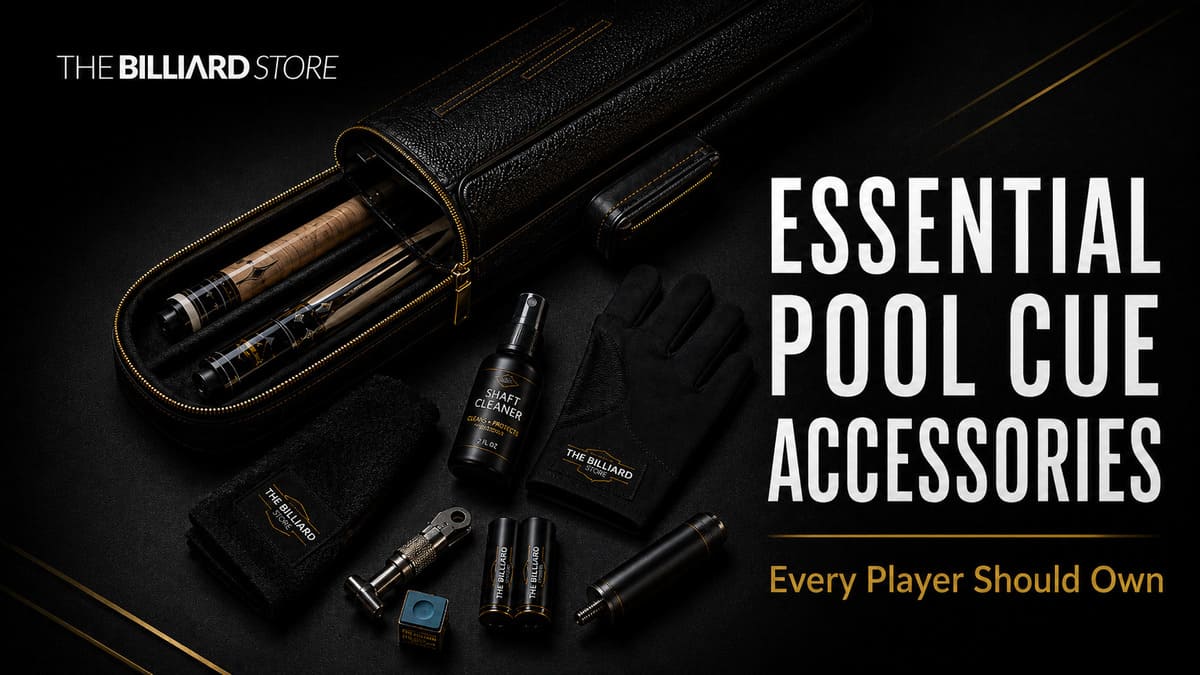
The right accessories can protect your cue, improve consistency, simplify maintenance, and prepare you for situations that occur during league matches, tournaments, and casual games.
Some accessories are necessary from the moment you purchase a cue. Others become useful as your experience and playing style develop.
Here are the most important pool cue accessories every player should consider.
1. A Protective Pool Cue Case
A cue case should be your first accessory purchase.
Pool cues are precision equipment. Shafts and cue butts can be damaged by moisture, extreme temperatures, impacts, poor storage, and accidental drops.
A protective case keeps the cue’s components organized and helps prevent scratches, dents, warping, and joint damage during transportation.
Cue cases are commonly described by the number of butts and shafts they hold. A 1×1 case holds one butt and one shaft. A 2×4 case typically holds two butts and four shafts.
A player who carries a playing cue, break cue, jump cue, and replacement shaft will need a larger case than a recreational player who owns one cue.
Hard cases generally provide stronger impact protection. Soft cases may be lighter and easier to carry. Hybrid designs attempt to combine structure with reduced weight.
Look for secure closures, comfortable straps, padded interiors, accessory pockets, and enough length for your cue components.
Do not buy a case based only on its appearance. Choose a model that protects your current equipment and gives you enough space for future additions.
2. Quality Billiard Chalk
Chalk increases friction between the cue tip and cue ball. Without adequate friction, the tip may slide across the ball and cause a miscue, especially when applying spin.
Players should chalk regularly rather than waiting until the tip looks completely bare.
Apply a thin, even layer across the entire tip. Avoid drilling a deep hole into the chalk cube with the center of the tip. This wastes chalk and may create uneven coverage.
Different chalk brands vary in texture, cleanliness, adhesion, price, and color. The best option is one that provides reliable coverage and feels comfortable in your routine.
Keep at least one extra piece of chalk in your case. League rooms and tournament venues may not always provide the type or color you prefer.
3. A Tip-Shaping and Scuffing Tool
The tip must retain an appropriate shape to contact the cue ball consistently.
Over time, a tip may flatten, glaze, or lose its ability to hold chalk. A tip tool allows the player to reshape or lightly scuff the surface.
Shaping creates the desired curvature. Scuffing opens the tip’s surface so it can accept chalk more effectively.
Use tip tools carefully. Removing too much material shortens the life of the tip and can create an uneven surface.
The goal is not to grind the tip before every session. Make small adjustments only when necessary.
Combination tools may include shapers, scuffers, burnishers, and tip picks. Choose a tool that is easy to control and appropriate for your tip material.
4. A Billiard Glove
A billiard glove creates a smooth surface between the shaft and the bridge hand.
Humidity, sweat, hand oils, and skin texture can cause friction during the stroke. A glove helps the shaft move through the bridge more consistently.
This can be particularly helpful in South Florida and other humid environments where equipment and hands may feel sticky.
Gloves are available in different sizes, materials, finger configurations, and hand orientations. Some cover three fingers, while others have open fingertips.
The glove should fit securely without restricting movement. A loose glove can bunch around the bridge, while a glove that is too tight may feel uncomfortable during long matches.
Not every player uses a glove, but it can be an inexpensive way to create a more consistent bridge.
5. Shaft-Cleaning Supplies
A clean shaft moves more smoothly through the bridge hand and feels more comfortable during play.
Traditional wood shafts can accumulate chalk, dirt, moisture, and hand oils. Carbon-fiber shafts also collect surface residue even though they are less porous.
Use products approved for the material of your shaft. A cleaner intended for wood may not be appropriate for carbon fiber, and an aggressive household product can damage either surface.
Keep a clean microfiber or cue towel in your case. Wiping the shaft after playing can reduce buildup and make deeper cleaning less frequent.
Never use sandpaper or abrasive pads without understanding the manufacturer’s recommendations. Repeated abrasion can change the diameter, finish, or warranty status of a shaft.
6. Joint Protectors
Joint protectors cover the joint pin and shaft insert when the cue is disassembled.
The joint components must remain clean and undamaged so the cue connects securely. Dirt, impact, and damaged threads can affect assembly and alignment.
Joint protectors are small, affordable, and easy to store. Many are designed to match specific pin types, so verify compatibility before purchasing.
Install them every time the cue goes into its case. This simple habit can protect one of the most important connection points on your equipment.
7. A Cue Extension
A cue extension adds temporary length to help the player reach difficult shots without stretching excessively or using an unstable bridge.
Extensions may attach to the rear of the cue, connect at the joint, or use a manufacturer-specific quick-release system.
They are especially useful on large pool tables when the cue ball stops near the center and the player cannot establish a comfortable stance.
An extension does not replace a mechanical bridge in every situation. However, it can help the player preserve normal stroke mechanics on shots that are only slightly beyond comfortable reach.
Before ordering, confirm that the extension is compatible with your cue model or bumper system.
8. A Break Cue
Although technically another cue rather than a small accessory, a break cue is an important addition for frequent players.
Break cues are designed to withstand the force of the opening shot. They typically use durable tips and construction intended for efficient energy transfer.
Using a separate break cue protects the playing tip from repeated high-impact breaks. It also allows the player to choose a break setup without changing the playing cue.
A beginner can use one cue for all shots while learning. League and tournament players often find that a dedicated break cue improves equipment organization and protects their main cue.
9. A Jump Cue or Break-and-Jump Cue
A jump cue is shorter and lighter than a standard playing cue and is designed for legal jump shots.
Jumping requires practice, correct technique, and an understanding of the rules used by your league or tournament.
A break-and-jump cue combines two functions. A removable section allows the cue to be shortened for jump shots.
This can be a convenient option for players who want to reduce the number of full cues they carry.
Before using a jump cue, make sure jump shots are permitted in the location and rule system under which you are playing.
10. A Bridge Head
A portable bridge head can be attached to a spare cue or dedicated bridge stick when the house equipment is damaged or unavailable.
Bridge heads are available in different shapes and heights, giving the player options for shooting over balls or reaching across the table.
A compact removable bridge head takes up very little room in a cue case and can be valuable during league travel.
Practice with it before competition. Players often struggle with the mechanical bridge because they use it only when a difficult shot occurs.
11. A Cue Towel
A cue towel serves several purposes. It can wipe moisture from your hands, remove residue from a shaft, clean chalk dust from equipment, and protect components while assembling the cue.
Choose a soft, lint-free material. Avoid using the same dirty towel indefinitely, since trapped grit can scratch polished surfaces.
Wash or replace the towel regularly and store it in a separate case pocket when possible.
12. Replacement Tips and Maintenance Services
Players who compete regularly should pay attention to tip wear before it becomes an emergency.
A tip that is extremely thin, loose, cracked, mushroomed, or unable to hold chalk may need professional attention.
Installing a cue tip correctly requires proper tools and experience. An uneven tip or damaged ferrule can affect performance.
Know where to obtain qualified cue repair and consider having the tip inspected before an important event.
Carrying a replacement tip may be useful, but professional installation is generally preferable to attempting a rushed repair without the proper tools.
How to Organize Your Cue Case
A well-organized case makes it easier to find equipment between matches.
Keep cues and shafts in the protected main compartments. Use accessory pockets for chalk, gloves, tip tools, joint protectors, extensions, towels, and small maintenance products.
Avoid placing loose metal tools directly against finished cue components. Make sure liquid cleaners are sealed tightly and stored away from wood or fabric.
Periodically remove everything from the case, discard worn items, clean the pockets, and check your equipment for damage.
Build Your Equipment Collection Gradually
You do not need to buy every billiard accessory at once.
Begin with a protective case, quality chalk, a cue towel, and a basic tip tool. Add a glove, joint protectors, cleaning supplies, and an extension based on your needs.
As you begin competing more often, consider a break cue, jump cue, larger case, or replacement shaft.
Purchase accessories that solve an actual problem or protect your investment rather than buying equipment simply because another player carries it.
Shop Pool Cue Accessories With Expert Assistance
The right billiard accessories can protect your cue and make every playing session more comfortable and organized.
The Billiard Store carries cue cases, extensions, maintenance products, gloves, and other equipment for recreational, league, and tournament players. Its online inventory currently includes dedicated categories for accessories, cases, cues, and shafts.
Browse the available billiard accessories online or call (561) 736-7665 for help selecting products compatible with your cue.
A small investment in proper protection and maintenance can help your equipment perform consistently and last for many years.
