
Blog
Playing Cues vs. Break Cues vs. Jump Cues: What Is the Difference?
Aug
New players often begin with one cue for every shot. That is a practical way to learn, and a quality playing cue can handle normal recreational use. As players join leagues, practice more often, or compete in tournaments, many add specialty cues designed for the break and legal jump shots.
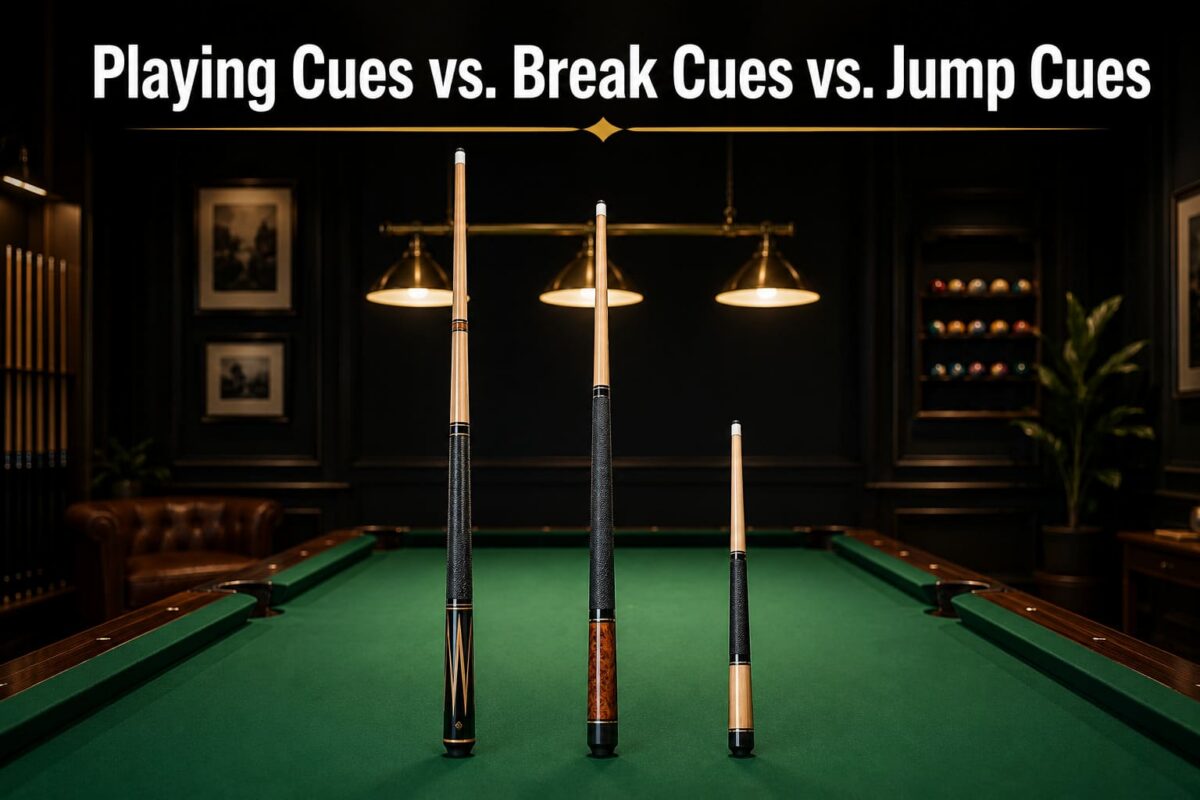
Playing cues, break cues, and jump cues may look similar, but they are built for different jobs. The distinctions involve length, balance, shaft construction, tip hardness, energy transfer, and control. Understanding those differences can help you protect your playing cue and choose equipment that supports your game.
What Is a Playing Cue?
A playing cue is designed for the wide range of shots used after the break. It should support speed control, accuracy, spin, touch, and a comfortable repeatable stroke. Players use it for stop shots, draw, follow, sidespin, position routes, safeties, combinations, and routine pocketing.
Playing cues are available with traditional wood shafts, low-deflection wood shafts, and carbon-fiber shafts. Tip diameters, tapers, joints, wraps, and balance points vary. These options allow players to choose a feel that matches their bridge, stroke, and preferred games.
Playing tips are selected for control and feedback rather than maximum impact resistance. Different hardness levels can perform well when properly shaped and maintained.
What Is a Break Cue?
A break cue is designed for the opening shot, when the player wants to transfer controlled power into the rack. It typically uses a harder, more durable tip and construction intended to withstand repeated high-impact strokes.
The objective is not simply to make the heaviest cue possible. An effective break combines cue speed, accurate contact, body control, rack quality, and table conditions. A dedicated break cue provides a consistent setup and prevents the playing tip from absorbing hundreds of forceful impacts.
Break cues use different shafts, weights, and tapers. The right choice allows accurate contact and repeatable speed without causing the player to lose balance.
Why Not Break With a Playing Cue?
Many recreational players safely break with a standard cue, particularly at moderate speed. The concern increases when a player uses a thin shaft, softer tip, or maximum-force break repeatedly.
High-impact breaks can flatten, mushroom, loosen, or glaze a playing tip. They may also place additional stress on the ferrule, shaft, and joint. A dedicated break cue preserves the setup and condition of the playing cue while providing a tip designed for the task.
What Is a Jump Cue?
A jump cue is a shorter specialty cue designed to execute legal jump shots. The player strikes downward through the cue ball so it leaves the cloth, clears an obstructing ball, and returns to the table.
Jump cues are lighter and shorter than standard playing cues. Their hard tips and compact construction help create the quick energy transfer needed for elevation. They are not intended for ordinary full-table play.
Legal jump technique is different from scooping under the ball, which can damage cloth and is a foul under common rules. Learn correct technique and practice on suitable equipment.
Rules vary. Some leagues, tournaments, and rooms prohibit jump cues or limit their use. Always confirm the applicable rules before assembling one during a match.
What Is a Break-and-Jump Cue?
A break-and-jump cue combines two functions. In its full-length configuration, it serves as a break cue. A removable butt section allows it to convert into a shorter jump cue.
The main advantage is convenience: one system performs two specialty jobs. Separate cues may offer more specialized balance, while a combination cue saves case space and can reduce cost.
Tip Materials and Maintenance
Playing cues commonly use leather tips in different hardness levels, although designs vary. Break and jump cues may use very hard leather, phenolic-style materials, or other specialized tips allowed by the applicable rules.
Hard tips can transfer energy efficiently but require controlled chalking and accurate contact. A tip that is cracked, loose, excessively flat, or damaged should be serviced. Never use an abrasive tool aggressively, especially on a hard specialty tip.
Check the rules of the league or tournament because permitted tip materials can differ. Equipment sold for one rule system may not be approved in another.
Do Beginners Need Three Cues?
No. A new player can learn stance, alignment, stroke, speed control, and position play with one reliable playing cue. A break cue becomes useful when the player practices regularly, breaks with greater speed, or wants to protect the playing tip.
A jump cue should come later, after the player develops fundamental cue-ball control and understands the rules. Jumping is a specialized skill, not a shortcut for poor position play.
Build equipment gradually. Start with the cue used on nearly every shot, add a break cue when it solves a clear need, and consider a jump cue when competition and skill justify it.
Shop Playing, Break, and Jump Cues
Specialty cues allow each piece of equipment to perform a defined job. A playing cue provides touch and control, a break cue handles repeated opening-shot impact, and a jump cue supports legal elevated shots.
The Billiard Store offers playing cues, break and jump cues, shafts, cases, extensions, and maintenance accessories from established billiard manufacturers. Browse the online categories or call (561) 736-7665 for help comparing cue types and compatibility.
Choose equipment that supports accurate technique, protects your investment, and fits the rules and level of competition in which you play.
